Prime Plumbing & Gasfitting

TMV vs Backflow Testing — When Do You Need Each, and Can One Plumber Do Both?

TMV vs Backflow Testing — When Do You Need Each, and Can One Plumber Do Both? — a Prime Plumbing & Gasfitting plain-English guide to tmv vs backflow testing for Melbourne facility managers. Below we cover what works, what doesn't, and when to call a licensed plumber.

Quick answer: TMV testing checks that hot water leaving a tap stays at a safe temperature for vulnerable users (children, elderly, hospital patients) — annual, under AS/NZS 4032.3. Backflow testing checks that contaminated water can't be siphoned back into the public water main — annual, under AS 2845.3. They're entirely different devices testing different risks, with different reporting requirements. But the same Victorian plumber, holding both the TMV testing endorsement and the Backflow Prevention Endorsement, can carry out both tests on the same site visit and produce both annual reports together. Most Melbourne facilities that need one also need the other.

What each test actually does

TMV testing — hot water temperature safety

A thermostatic mixing valve sits on the hot supply line just upstream of an outlet (basin, shower, bath). It blends hot water from the storage system (which may be 60-70°C to prevent Legionella) with cold water to produce a controlled mixed-water temperature at the outlet — usually 38°C for healthcare and aged care, sometimes 43.5°C in less-vulnerable commercial settings.

The risk it manages: scalding. An elderly resident or young child can sustain a serious burn from water above 50°C in just a few seconds.

What the annual test checks:

  • Outlet mixed-water temperature is still in tolerance
  • If the cold supply fails, the valve cuts hot within 5 seconds (failsafe)
  • If the hot supply fails, the valve cuts hot cleanly
  • No cross-flow between hot and cold supplies

Backflow testing — water contamination prevention

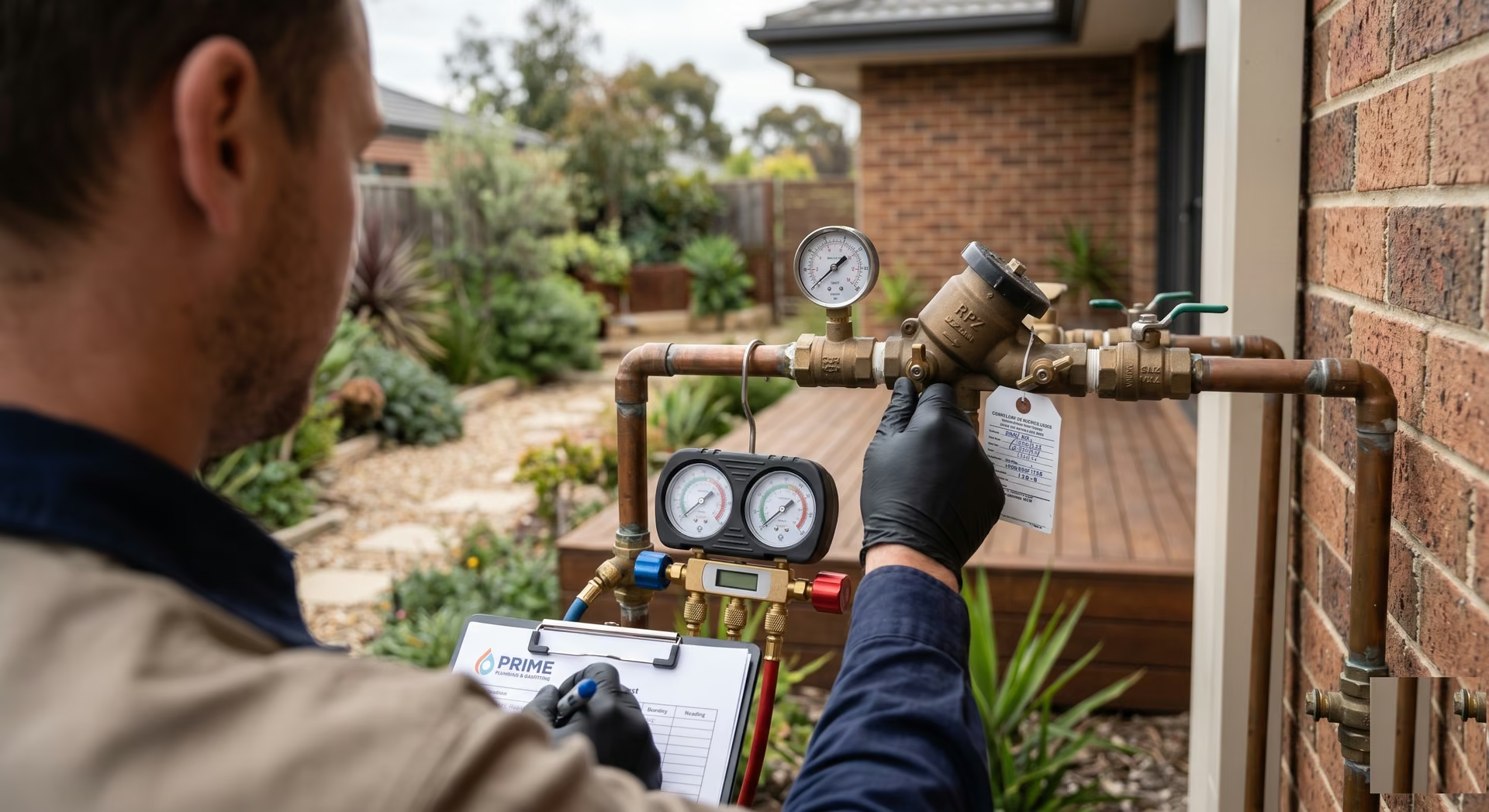
A backflow prevention device sits on the incoming water main (or on a specific high-risk branch). Different designs for different risk levels:

  • RPZD (Reduced Pressure Zone Device) — high-hazard premises (medical, dental, factories with chemical processes, food retail with grease-trap, irrigation with chemical injection)
  • DCV (Double Check Valve) — medium-hazard premises (many commercial properties, some apartment buildings)
  • Single check / dual check — low-hazard residential and small commercial

The risk it manages: during a pressure drop on the public water main (a burst main, a fire-hydrant draw, peak demand) water can flow backwards from a property into the public supply, carrying whatever contamination existed in the property's plumbing. The backflow device mechanically blocks that reverse flow.

What the annual test checks:

  • The device's check valves still seat fully under reverse pressure
  • The pressure-relief vent (on RPZD) still activates within its rated range
  • Test cocks operate cleanly
  • No internal corrosion or particle damage to the valve assembly

Backflow testing — protecting the public drinking water supply

A backflow prevention device sits at the boundary where your property's plumbing meets the water authority's main, or at a specific high-risk branch (cooling tower, irrigation, chemical-feed). If pressure on your side drops below the main, water (potentially contaminated by whatever it has been sitting in on your side) can siphon back into the public supply. The device physically prevents that backflow. The annual test checks the device is still doing its job — relief valves opening at the right pressure, check valves sealing in the right direction, no internal leak. See our backflow prevention testing for the standalone service.

How the tests are different

| Aspect | TMV Test | Backflow Test | |---|---|---| | Australian Standard | AS/NZS 4032.3 | AS 2845.3 | | Endorsement required | TMV testing endorsement (BPC) | Backflow Prevention Endorsement (BPC) | | What's tested | Hot-water mixing accuracy + failsafe | Reverse-flow prevention + relief vent | | Test equipment | Calibrated thermometer probe | Calibrated pressure gauge kit + isolation tools | | Report lodged with | Facility records, AHJ on request | Water authority (Yarra Valley Water, South East Water, City West Water) | | Failed device action | Recalibrate, rebuild or replace; outlet stays in use after pass | Repair or replace; in some cases the water authority can disconnect supply | | Typical frequency | Annual (some intensive-care at 6 months) | Annual on all medium and high hazard devices | | Where the device is | At every TMV-protected outlet | At the property's water main inlet (or on a specific branch) |

Can the same plumber do both?

Yes — if they hold both endorsements. In Victoria, the relevant endorsements are issued by the Building and Plumbing Commission (BPC):

  • TMV testing endorsement — covers the AS/NZS 4032.3 test
  • Backflow Prevention Endorsement — covers the AS 2845.3 test (separate from the BPC general plumbing licence)

Not every Melbourne plumber holds both. Some specialise. When you're booking, ask for the endorsement numbers and confirm both are current — many facility-management contracts now require it explicitly on the contract.

Prime Plumbing & Gasfitting holds both. BPC #103414 covers the general plumbing licence; the Backflow Prevention Endorsement and TMV testing endorsement are both attached.

How to verify both endorsements are current

Ask the plumber for: BPC licence number (general plumbing), backflow prevention endorsement number, and TMV testing endorsement. Cross-check on the BPC public register at bpc.vic.gov.au — every active endorsement is listed against the licence. Some facility-management contracts now require contractors to provide endorsement screenshots from the register at contract execution and on annual renewal. Our commercial plumbing compliance page lists our current endorsements.

Why combining the tests on one annual visit is worth it

If your premises has both TMVs and backflow devices (most aged care, healthcare, childcare and body corporate properties do), running them as one combined annual visit has practical advantages:

  1. One visit, less property downtime. A single morning, all amenities back online by lunchtime, instead of two separate visit days.
  2. One quote. Fixed-price annual contracts that bundle TMV + backflow are usually 10-20% cheaper than booking them separately.
  3. One Compliance Certificate file. Both reports lodged at the same time, with the same site asset register update.
  4. One contractor for follow-up. If something fails at audit nine months later, the same plumber who tested it knows the site and the history.
  5. Combined visit slots match natural compliance windows. Most facilities prefer their annual compliance work clustered into one month each year, not spread across the calendar.

When combined visits are NOT a good idea

Two scenarios where you book separately: (1) Your backflow device is on a different access window from your TMVs — backflow is usually plant-room or carpark, TMVs are inside resident or patient areas — splitting the visit limits access disruption. (2) You have multiple TMVs that need progressive testing across the year for compliance staggering — some clinical-governance schedules require this. For both, our TMV testing service can be scheduled independently of backflow.

How combined testing pricing usually looks

Combined TMV + backflow annual contracts in Melbourne typically run:

  • Single-RPZD + 2-4 TMV site (small medical practice, small childcare): $350-$550 total
  • Single-RPZD + 8-15 TMV site (small aged care, body corporate): $650-$1,200 total
  • Multi-RPZD + 20+ TMV site (large aged care, hospital, multi-building): quote-by-site

These ranges are a guide only — the actual quote depends on access, device type/age, and how clustered the tests are.

Why the bigger combined sites get a quote, not a price-list rate

A hospital with 60+ TMVs, 4 RPZD devices, cooling-tower compliance, and trade-waste obligations is too custom for a flat per-device rate. Every additional compliance stream adds setup time, test equipment swaps, paperwork and lodgement. We quote against the actual device count plus the scope items after a single walk-through — see commercial plumbing compliance for the full assessment workflow.

Need TMV + backflow combined annual testing in Melbourne?

What happens if a device fails during the combined visit

A failed TMV gets rebuilt on site if we hold the service kit (we carry common Reliance and Caleffi kits on the van); replaced if rebuild parts are not available. A failed RPZD usually means replacement — common DN20-DN32 sizes are on the van, larger sizes are sourced and fitted within 5-7 business days, with the water authority notified of the planned remediation date. See backflow prevention testing for the device-failure workflow.

Call 0475 407 670 or send your property address through the form below. We'll quote a fixed-price annual contract covering both — one visit, two reports, one folder of paperwork.

Book combined annual testing →

When to Call a Licensed Plumber

Some plumbing problems are DIY-friendly; others need a licensed professional under Victorian law.

  • Photograph the issue and any visible water damage
  • Note when the problem started and what changed beforehand
  • Locate your main water shut-off valve before booking
  • Clear access around the affected fixture or appliance

Anything involving gas, sewer drainage, hot water units, backflow prevention, or work behind tiled walls must be handled by a licensed plumber or gasfitter.

FAQs

Possibly. Some properties only have backflow risk (e.g. a small commercial premises with no vulnerable users). But many properties have both risks and only one is on the auditor's radar. A site walk-through can confirm which devices you actually have.

Yes. Age doesn't reduce the testing requirement — if anything, older TMVs need more attention because the seals and thermostat element wear with use. Many 10+ year old TMVs need a rebuild at the annual test.

Yes. Annual testing applies regardless of last year's result. Yarra Valley Water tracks the device on their register and the testing window is 12 months from last test, not 12 months from last fail.

Depends on device count. A small medical practice with 1 RPZD + 3 TMVs is usually a 60-90 minute visit. A 20-TMV aged care facility is half a day. We confirm the scheduled duration in the quote.

One plumber with both endorsements does both tests. There's no separate trade required.
Before You Book

A quick checklist to share with your plumber when you book:

  • When did the issue start?
  • Is it isolated to one fixture or multiple areas?
  • Are there any visible leaks, smells or unusual sounds?
  • Have you turned off the relevant isolation valve?
Alister Williams, founder of Prime Plumbing & Gasfitting

If you're unsure, Prime Plumbing & Gasfitting can inspect the issue and explain the options before any work starts. Call 0475 407 670 or request a quote online.

Related plumbing topics:

Please enable JavaScript in your browser to complete this form.
Click or drag files to this area to upload.You can upload up to 20 files.
You can upload files like: JPG, JPEG, PNG, HEIC.

Related blogs

Prime Plumbing & Gasfitting
Prime Plumbing & Gasfitting, Melbourne’s trusted name in professional plumbing and gas services. I’m Alister Williams, a licensed plumber with over ten years of industry experience, proudly serving homes and businesses across Melbourne.

Support

  • Melbourne
  • admin@primeplumb.com.au
  • 0475 407 670
Copyright © 2025 Prime Plumbing & Gasfitting. all rights reserved.