Heat Pump Hot Water Noise: How Loud Are They and What Can You Do About It?
heat pump hot water noise: How loud is a heat pump hot water system? Typical decibel levels, where noise comes…


How Often Should a TMV Be Tested in Melbourne?, a Prime Plumbing & Gasfitting plain-English guide to how often should tmv be tested melbourne for Melbourne homeowners. Below we cover what works, what doesn't, and when to call a licensed plumber.
Quick answer: Australian Standard AS 4032.3 requires annual testing of every Thermostatic Mixing Valve installed in healthcare, aged-care, childcare, schools, and public buildings. Each valve gets a documented test (set temperature, pressure-shift response, cold-supply-failure response, strainer inspection) and a written report retained on-site. Failed valves must be taken out of service or repaired/replaced. Skipping testing exposes the facility to liability for any scald injury and may breach the facility's operating licence (childcare, aged-care, healthcare).
If you operate a regulated facility, childcare, aged-care, hospital, school, public building, and you've heard "annual TMV testing" mentioned, here's what the standard actually requires, what testing involves, and what skipping it costs you in legal and operational terms.
AS 4032.3 (in-service testing of Thermostatic Mixing Valves) requires:
The standard sits alongside AS/NZS 3500.4 Section 1.9.5 (which mandates TMVs in regulated premises) and the Plumbing Regulations 2018 (which enforces AS standards for licensed plumbing work in Victoria).
Your facility likely needs annual TMV testing if it falls into any of these categories:
| Premises type | TMV test frequency | Notes |
|---|---|---|
| Hospitals, day surgeries | Annual | Plus pre-/post-renovation |
| Aged-care facilities | Annual | Often quarterly visual checks too |
| Disability services / SDA | Annual | Resident-vulnerability driven |
| Childcare centres / kindergartens | Annual | Per ACECQA + AS 4032.3 |
| Primary schools, special schools | Annual | DEECD plumbing maintenance protocol |
| Public buildings with exposed basins | Annual | Local council requirement on most |
| Refurbishments adding TMVs | Initial commissioning + annual | First test must be commissioning per AS 4032.1 |
For ordinary residential premises with simple tempering valves (not TMVs), annual testing isn't required by the standard. Tempering valves are typically replaced at hot water unit replacement or every 5-10 years on inspection.
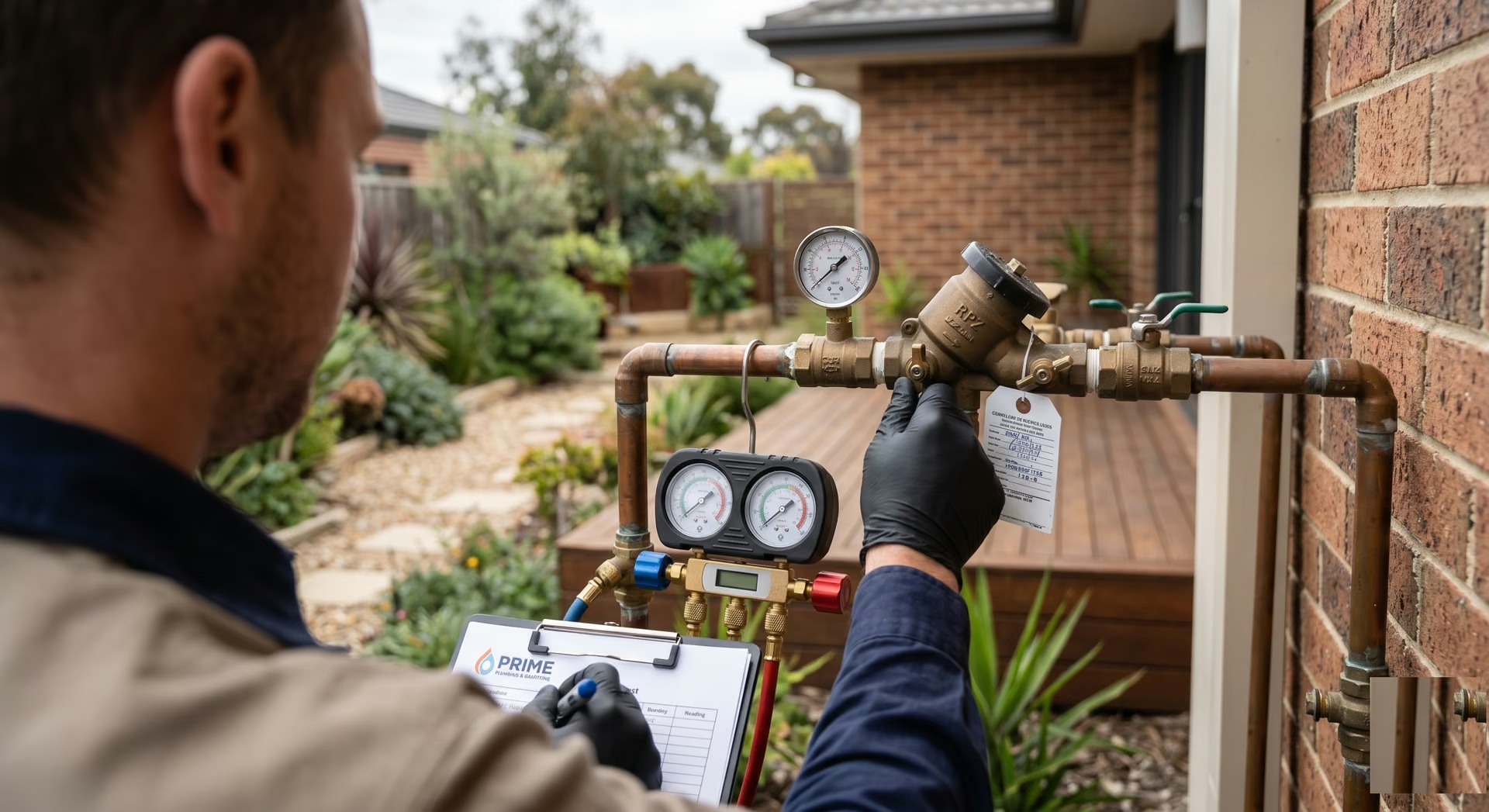
Five components per valve, takes a TMV-accredited plumber 10-15 minutes per valve once on-site:
The plumber measures the outlet water temperature at a representative tap, under normal flow, with both hot and cold pressures stable. Result is logged against the valve's nameplate set point (45°C or 50°C depending on application).
Cold water inlet pressure is varied (artificial drop in cold pressure) to confirm the valve maintains outlet temperature within tolerance, typically ±2°C of set point. Failure indicates a worn wax element or compromised internal balance.
Cold water inlet is fully shut. The valve must close the hot inlet within seconds, dropping outlet flow. Failure means scalding water could reach the outlet if cold pressure ever fully fails, a serious safety issue.
The integrated strainers on hot and cold inlets are inspected for sediment build-up. Cleaning is part of routine service; severely blocked strainers usually indicate the valve needs full service.
Each valve gets a documented report including: facility name, valve location, valve make/model/serial, set temperature, all test results (measurements + pass/fail), technician name and licence number, date, and recommendations (continue in service / service required / replace).

Per-valve testing is the smallest cost, most facilities have multiple valves so the total scales by count. We quote annual contracts based on:
Small healthcare practices with 2-4 valves are at the cheapest end. Large aged-care facilities with 30-100 valves are bigger annual contracts but per-valve cost drops with scale.
Three practical steps:
You need to know how many TMVs are installed and where. Older facilities sometimes lack good records. We can do a facility audit as part of the first visit, walking the building, identifying every TMV-protected outlet, noting valve makes/models, building an asset register if one doesn't exist. The audit is a one-off cost; ongoing annual testing is then straightforward.
Most facilities batch testing around either the calendar year (Jan-Feb) or the financial year (Jul-Aug) for budget reasons. Either works as long as the next test is within 12 months of the prior.
The written reports for the past 3 years should be readily accessible, at minimum to the facility manager, ideally also to anyone responsible for compliance audits. We provide PDF copies that can be uploaded to your facility management system.
Caulfield aged-care facility: 28 resident bathrooms + 4 staff areas = 32 TMVs across two buildings. Annual testing schedule batched into a single half-day visit. Three valves drifted outside tolerance and were replaced on the same visit (we carry common spares for this reason). Written reports filed in the facility's asset register.
Bayside primary school: 8 TMVs across staff and student bathrooms. Annual testing scheduled during school holidays so testing doesn't interrupt classes. All passed in the most recent test; previous year had identified and replaced one drifting valve.
Glen Iris GP practice: 4 TMVs (3 patient, 1 staff). Smallest annual contract we run, batched with other small facilities in the same suburb to keep travel cost down.
Book a TMV testing visit if:
Prime Plumbing & Gasfitting performs AS 4032.3 TMV testing across Melbourne, particularly across the eastern, south-eastern, inner-east and bayside healthcare, education and aged-care corridor. See all suburbs we service
Send your facility name, address, approximate valve count, and any prior testing history through the contact form, or call 0475 407 670 for a phone quote.
Related: What is a Thermostatic Mixing Valve? · TMV Testing Melbourne · Tempering Valve Replacement Melbourne
About the author
Alister Williams is the founder and lead plumber of Prime Plumbing & Gasfitting. He's been licensed under BPC #103414 for over a decade, is licensed for gasfitting with the Building and Plumbing Commission, is TMV-accredited for AS 4032.3 testing, and is a member of the Master Plumbers Association of Victoria.

Two paths depending on the failure:
If the failure is a dirty strainer or a drift within tolerance for service (e.g. set temperature drift of 1-2°C above tolerance), the valve can sometimes be cleaned and re-tested on the same visit. The wax element itself is the limiting factor, once it's drifting, replacement is usually more economical than service.
If the failure is outside service tolerance (e.g. outlet temperature exceeds 47°C on a 45°C-set valve, or the cold-supply failure test shows hot still flowing), the valve must be replaced. Out-of-service immediately if there's a real scald risk; service-grade fix scheduled if the failure is borderline.
The valve replacement is a separate plumbing visit (or same-visit if the spare valve was carried) and the new valve gets a commissioning test per AS 4032.1 before being put in service.


The risks scale by facility type:
| Facility type | Risk if testing skipped |
|---|---|
| Aged-care | Resident scald injury operator liable; potential aged-care accreditation breach |
| Childcare | Child scald injury operator liable; potential ACECQA enforcement action |
| Hospital / day surgery | Patient scald injury liability + possible Health Department audit failure |
| School | Child scald injury DET investigation + potential operator liability |
| Public building | Visitor scald injury council liability if known unmaintained |
Beyond compliance, insurance is the practical issue. Most facility insurers require evidence of compliance with applicable AS standards, and a scald injury claim with no AS 4032.3 testing record on file is generally a fight you don't want to have with your insurer.
Some plumbing problems are DIY-friendly; others need a licensed professional under Victorian law.
Anything involving gas, sewer drainage, hot water units, backflow prevention, or work behind tiled walls must be handled by a licensed plumber or gasfitter.
Yes, the commissioning test under AS 4032.1 is required at install, and annual testing under AS 4032.3 starts 12 months after commissioning. New valves still need their initial baseline recorded.
Only if they hold the relevant accreditation (TMV testing accreditation requires specific training plus the underlying plumbing licence). For most facilities, an external TMV-accredited plumber is more practical and cheaper than training in-house staff for what's a small annual job.
The next test should be done as soon as possible. Document why the gap occurred (illness, contractor change, etc.) and resume the annual cycle. Insurance and compliance auditors look for the pattern of testing, not perfect adherence, but a multi-year gap is harder to defend.
With the facility. The test report is a facility compliance record, not a per-valve sticker. Some facilities photocopy the report into a folder near each TMV cluster as a quick reference, but the original lives in the facility's compliance documentation.
Typical service life is 5 years before the wax element starts drifting. Some installations get 7-8 years; some need replacement at 4. Annual testing catches drift before it becomes a safety issue.
Tempering valves don't require AS 4032.3 testing. They're inspected at hot water unit replacement or every 5-10 years on a service visit. If your facility is in one of the regulated categories above, you should have TMVs not tempering valves: confirm with a facility audit.
Generally no, the AS 4032.3 testing requirement applies to all TMVs in regulated premises regardless of how many or how rarely used. Even a single TMV-protected outlet that's used once a month is in the testing schedule.
A quick checklist to share with your plumber when you book:

If you're unsure, Prime Plumbing & Gasfitting can inspect the issue and explain the options before any work starts. Call 0475 407 670 or request a quote online.