Leaking Shower Repair Cost in Melbourne: Shower Leak Prices by Cause
Leaking shower repair cost in Melbourne: typical quoted ranges for a mixer, pipe, grout or silicone fix and a failed…
Bidet installation cost depends mostly on which kind of bidet you buy, and only a little on the plumber's time. A handheld spray is a short job on the water supply to the toilet. An electric seat needs a power point as well. A standalone bidet pan next to the toilet is closer to installing a second toilet, with its own water and waste. This guide covers each type, the ranges Australian cost guides publish, and what a quote should and should not include. If you already know what you want fitted, see our bidet installation page.
Quick answer: Australian cost guides put a handheld bidet spray at roughly $150 to $250 all up, a non-electric attachment at roughly $200 to $500, an electric bidet seat at roughly $300 to $700 before any new power point, and a standalone bidet pan at roughly $1,200 to $2,500. A new power point for an electric seat is a separate electrician's job, with one guide putting it at around $150 to $300. These are published guide figures, not a Melbourne quote.
Want a firm price? Tell us the type and model, or send a photo of the bathroom to 0475 407 670, Mon-Fri 7-5, Sat 8-1. Check the suburbs we cover.
When someone asks what a bidet costs to install, the useful answer starts with a question back: which one?
All three connect to your drinking water supply, which is licensed plumbing work in Victoria. That includes the T-piece fitting: a bidet connected to the water supply needs a licensed plumber in every Australian state. Our guide to what plumbing you can do yourself in Victoria covers where that line sits.
These figures come from Australian retailer buying guides, because plumbers rarely publish prices for this job. They are a guide to the shape of the market. Retailer guides can also run lower than a plumber's call-out and minimum charge, so a real quote may sit above the bottom of a range.
The same first guide notes that labour in Melbourne and Sydney can cost more than the national figures. Where the guides differ, it is mostly the brand of unit and whether the electrician is included.
Electric seats heat the water and the seat, and they need power. Most Australian bathrooms have no power point near the toilet, so this is where the cost can jump.
Bathroom power is electrician's work, and Prime Plumbing & Gasfitting does not do it. A licensed electrician needs to check the bathroom electrical zones and do any new outlet or wiring work. An outlet being within reach of the toilet does not mean it is in a compliant spot. The plumber handles the water, and the electrician handles the power. For a seat that is going on a toilet with no power nearby, ask for the electrician's quote separately, and ask who is coordinating the visit.
If you are building or renovating, the cheapest time to add the outlet is before the walls are closed up, along with the water outlet behind the cistern.
A seat also needs decent water pressure and a free place for the isolation tap. We can check the supply and the toilet before you buy, so the seat fits the toilet you have.
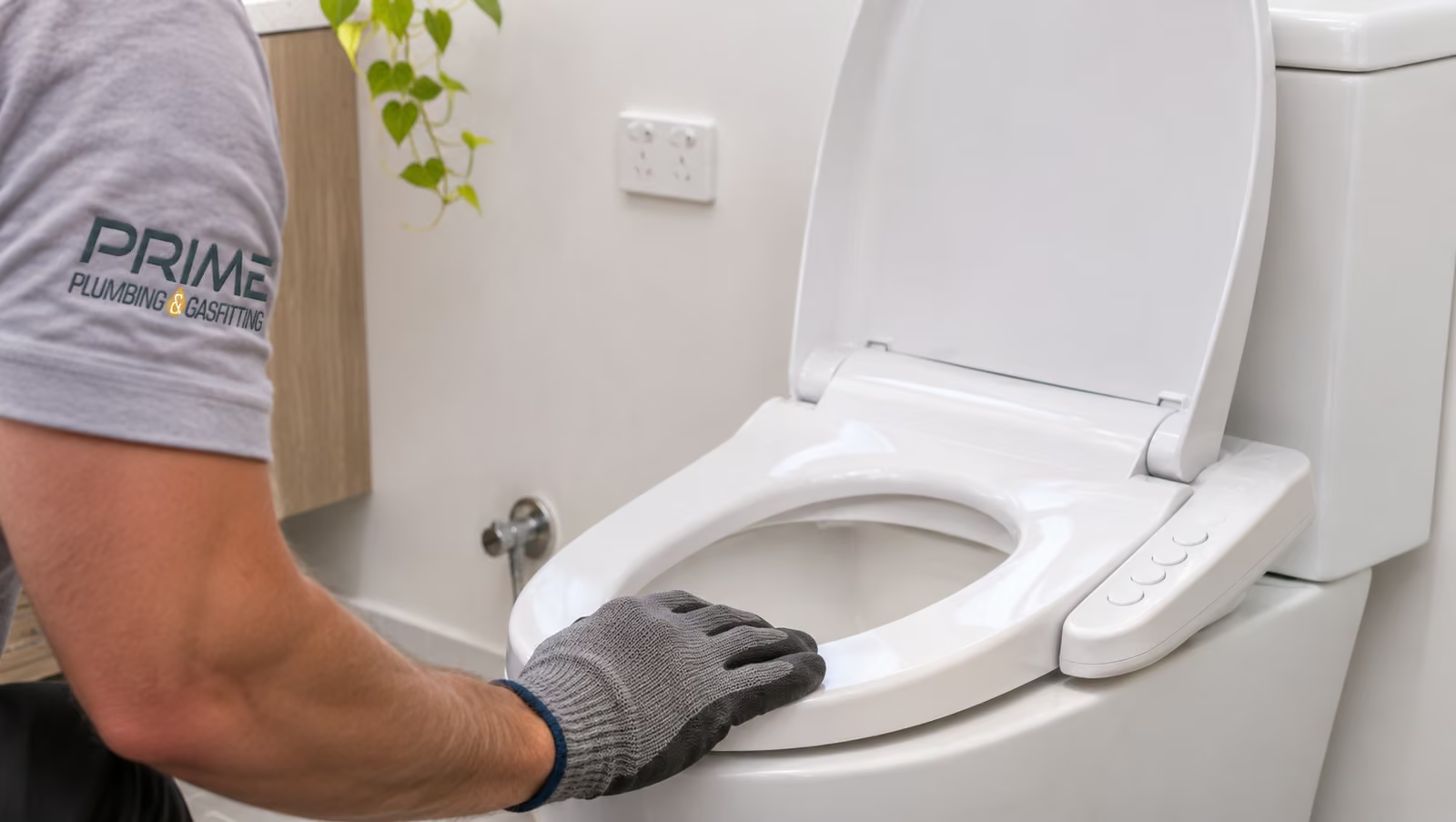
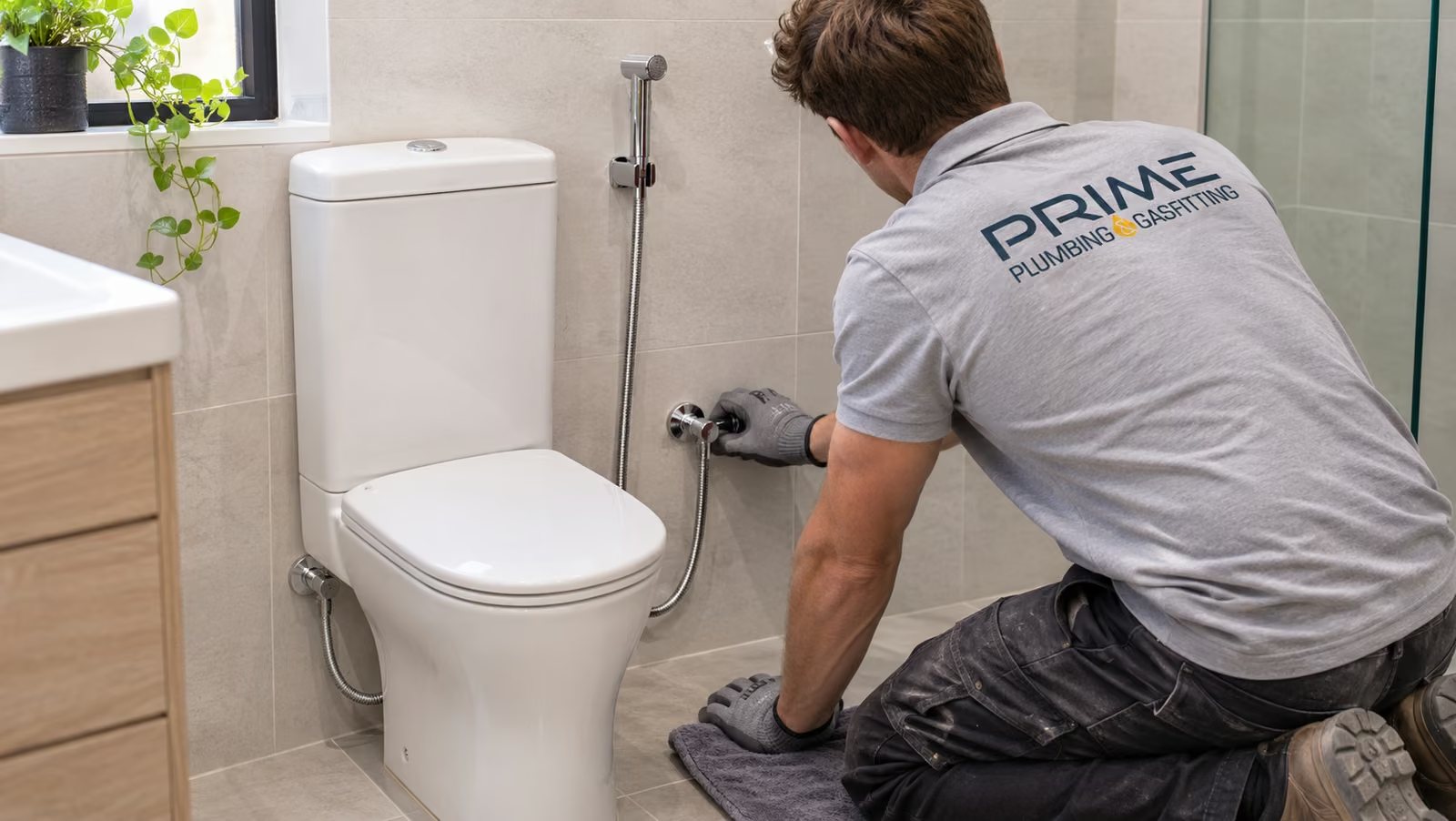
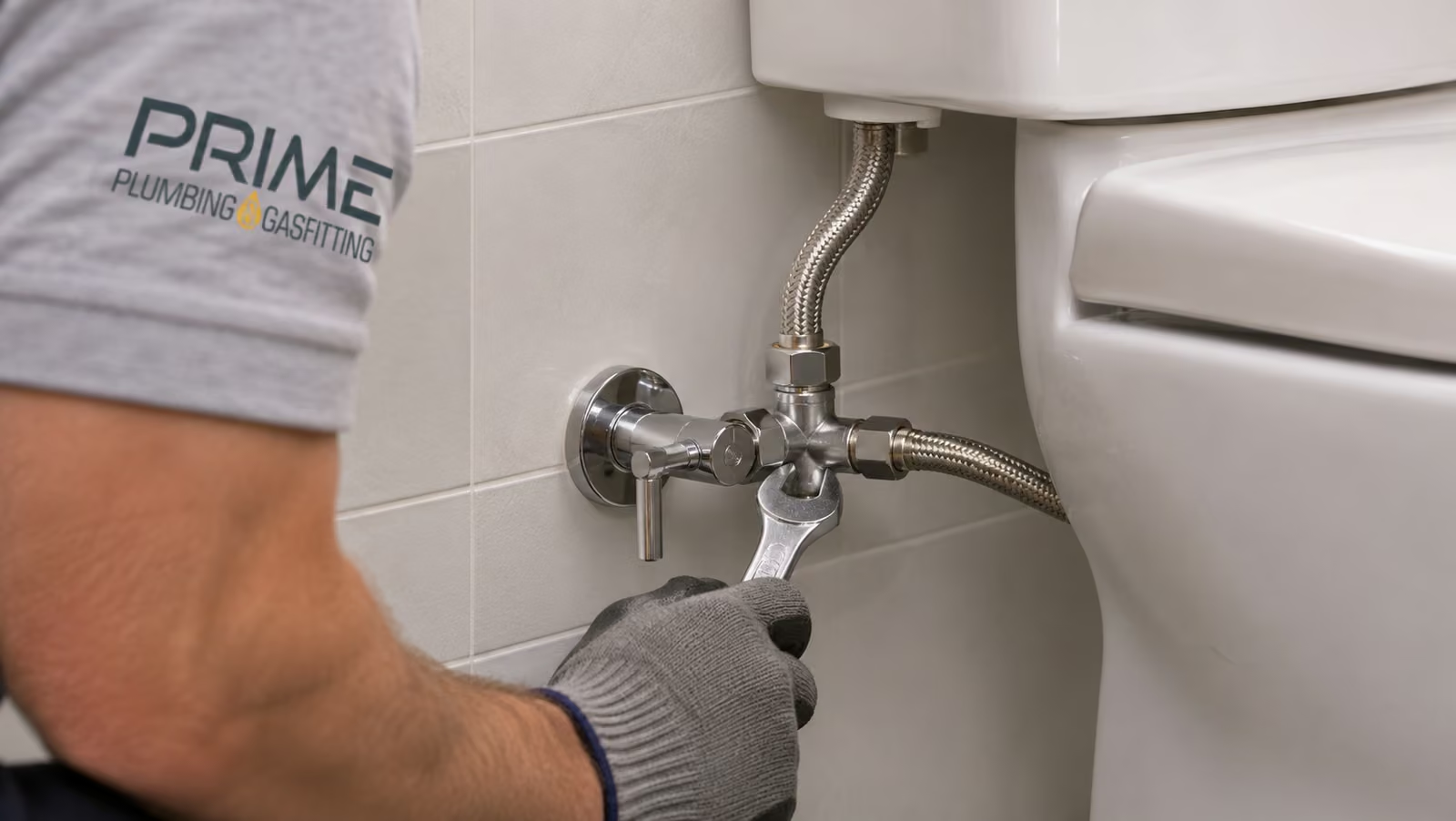
This is the cheapest end, and the one most people search for. A handheld spray or non-electric attachment is fitted to the cold supply feeding the cistern. A plumber fits a T-piece, an isolation tap if there is not one already, and the hose, then mounts the holder or spray on the wall or toilet.
The cost figures above split roughly as $50 to $200 for the unit and $100 to $250 for the labour. If the existing isolation tap is stiff, corroded or missing, replacing it adds time. If the cistern is a concealed in-wall type, access is harder and the job is bigger.
Some handheld sprayer installs may need backflow prevention, and some retailers list it as an extra. Ask the plumber what the product you are buying needs, and whether it is included in the price. Our guide to what backflow prevention is explains the idea.
Another small point: a brand new T-piece or hose that is not tightened properly is one of the common causes of water around the base of a toilet, so see toilet leaking onto the floor if you spot damp after a DIY attempt.
| Bidet type | Typical published total | What that total covers |
|---|---|---|
| Handheld bidet spray | $150 to $250 | The spray kit, a licensed plumber fitting the T-piece and hose, and an isolation valve where needed. No electrical work. |
| Non-electric bidet attachment | $200 to $500 | The attachment, plus a licensed plumber connecting it to the cistern supply. |
| Electric bidet seat | $300 to $700, plus an electrician if there is no power point | The seat, plumber connection to the cistern supply, and fitting the seat. A new power point is extra. |
| Standalone bidet pan | $1,200 to $2,500 | The pan, water supply, a waste connection and fixing it to the floor. Tiling and floor repairs are extra. |
| Smart toilet with built-in bidet | $1,500 to $4,000 | The unit, removing the old toilet and fitting the new one, plus plumbing and electrical connections. |
| Licensed plumber | Licensed electrician | You or other trades |
|---|---|---|
| Connecting to the drinking water supply, including the T-piece | Fitting a new power point in the bathroom, where an electric model needs one | Choosing and buying the unit |
| Isolation tap and flexible hose to the cistern | Checking the position suits the bathroom electrical zones | Tiling or floor repairs around a new pan |
| Waste connection for a standalone pan | Wiring a smart toilet where the model needs it | Removing and storing the old seat |
| Compliance Certificate where the work needs one | Advising on where an outlet can legally go | Painting or wall repairs after a new outlet |
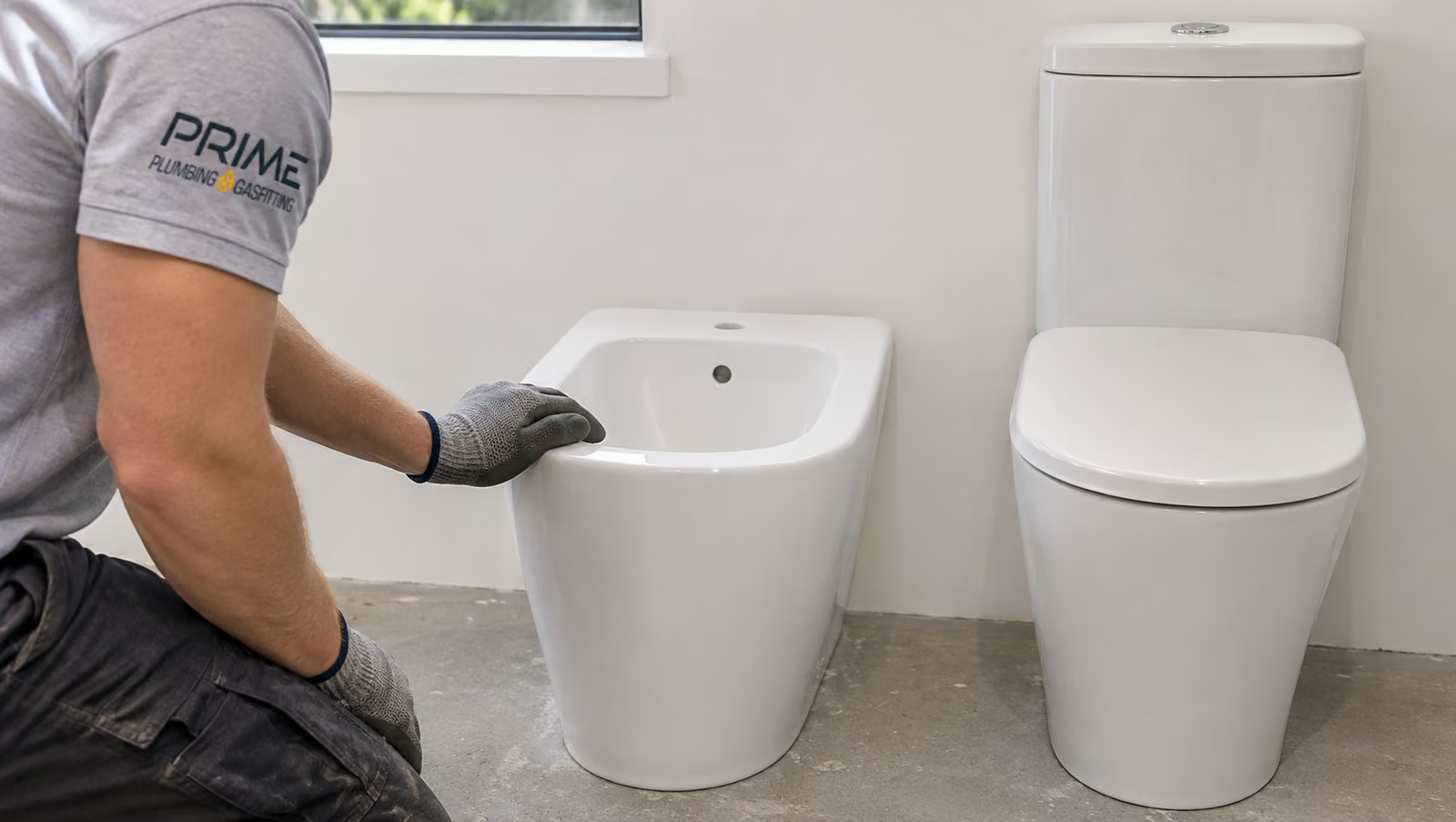
A separate bidet pan is a different scale of job. It needs floor or wall space beside the toilet, a water supply, a mixer or taps, and a waste connection to the drain. It is the one type where the guides list plumbing costs of $400 to $1,000 on top of the installation figure, and the total goes up to $1,200 to $2,500 for that reason.
What pushes it up or down:
If you are renovating the bathroom anyway, the bidet pan is cheapest to place at the same time as the toilet, before the floor is tiled.
A fair quote names the type, says what is supplied and by whom, and lists any exclusions. Check these four points.
WaterMark. The BPC says tapware, toilets and sanitary ware, and any product that touches drinking water, must carry the WaterMark logo, and that a licensed plumber is prohibited from installing a product that needs it and does not have it. Check the box or the product page before you buy, especially for overseas or second-hand bidet products. The BPC points to the ABCB WaterMark database for checking.
A published price range tells you the market. A fixed quote after the plumber has seen the bathroom tells you your number. Prime Plumbing & Gasfitting gives that fixed quote after seeing the job, and a photo of the toilet, the wall behind it and the product link is usually enough to start the conversation.
These details save a second phone call.
If you have not bought the unit yet, say so. A plumber can check the supply and layout before you spend money.
Australian cost guides put it at roughly $150 to $250 for a handheld spray, $200 to $500 for a non-electric attachment, $300 to $700 for an electric seat and $1,200 to $2,500 for a standalone pan. Those are guide figures. A fixed quote after seeing the bathroom is the real number.
The kit itself is $50 to $100 and the plumber time is about $100 to $150 in the published guides, about $150 to $250 all up. A stiff or missing isolation tap, or a concealed cistern, can add to the labour.
If you supply the kit, you are paying for the plumber's time on the T-piece, hose and isolation tap, which the published guides put at about $100 to $150. Ask whether a minimum call-out applies, since a short job may be priced above the bottom of that range.
About $150 to $300 for a new power point, according to one guide, and nothing extra if a suitable outlet is already within reach. Most Australian bathrooms have none near the toilet, so a licensed electrician usually fits one. The plumber handles the water connection only.
Not legally for anything that connects to your drinking water. Better Health Victoria says all household plumbing work must be done by a licensed plumber, and a retailer guide says the same for bidet attachments and seats, including the T-piece.
Only when the job, materials and appliance included, adds up to more than $750. That is more likely on a standalone pan or smart toilet than a handheld spray. Ask the plumber whether it is included in the quote.
Before you accept a price, check it spells out:

Want a fixed price for your bidet? Prime Plumbing & Gasfitting installs bidets across Melbourne, from handheld sprays to standalone pans, and gives a fixed quote after seeing the job. Alister is a licensed plumber and gasfitter. For an electric seat, we do the water connection and your electrician does the power. See our bidet installation page for what we fit.
Call 0475 407 670. Hours are Mon-Fri 7-5, Sat 8-1. Prefer to write? Use the contact page, or check the suburbs we service.
Related plumbing topics: