Low Water Pressure in the House: Causes and What a Plumber Checks
Low water pressure in house taps or the shower? How to tell if it is one tap, the hot side…

If you have a sewer smell in bathroom drains, at the toilet base or drifting through the house, sewer air is getting past a seal that should be holding it back. Most of the time that seal is a trap that has dried out, or a shower waste full of hair and soap, and you can sort both yourself in a few minutes. The rest are faults in the pipework that a licensed plumber needs to find and fix.
Quick answer: Make sure it isn't gas first. A rotten-egg smell near a gas appliance or the meter is a gas emergency. If the smell is clearly coming from the drains, run water into every fixture you rarely use, floor wastes included, then clean out the shower waste and the basin overflow. If it is back within a day or two, sits around the toilet base, comes with gurgling, or turns up with slow drains all over the house, stop there and call a licensed plumber.
Smell won't go away? Call 0475 407 670. Mon-Fri 7-5, Sat 8-1. See if we cover your suburb.
Sewer air and natural gas can smell alike. Sewer gas carries hydrogen sulphide, which smells like rotten eggs, and the gas piped to Victorian homes has an odorant added so that a leak smells much the same. Before you start lifting grates, work out which one you are dealing with.
If there is any chance it is gas, treat it as gas. Energy Safe Victoria's advice is to turn the gas off at the meter, or at the cylinder if you have bottled gas, if that is safe to do, put out any flames, leave electrical switches and devices alone, open doors and windows, keep people away, and ring the emergency number on your gas bill. Call 000 if anyone's life is at risk. Our guide on what to do if you smell gas in your house goes through each step. Gas work is licensed only, so once the area has been made safe, a licensed gasfitter has to find and repair the leak. That part is our gas leak detection service.
Once you are sure it is the drains, open a window and run the exhaust fan while you work through the checks below.
All you need is a bucket, gloves and an old brush. None of these steps counts as plumbing work (see what plumbing you can do yourself in Victoria).
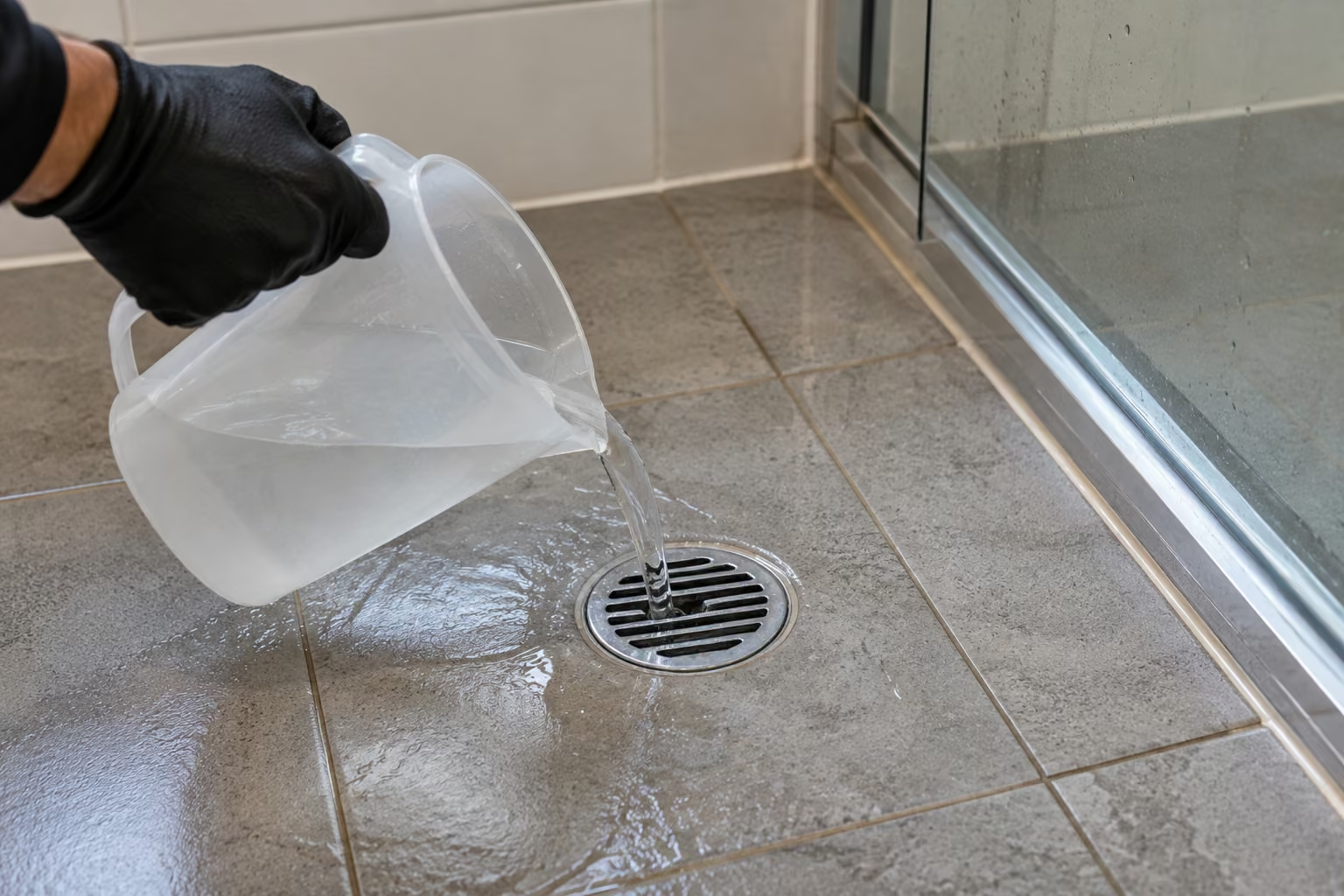
Every basin, shower, bath, trough, floor waste and toilet has a trap: a bend in the pipe that holds a little water. That water is the only thing stopping sewer air from coming back up the pipe into the room. When a fixture sits unused, the water slowly evaporates and the smell comes straight in.
The likely ones are a spare shower, a floor waste, an ensuite nobody uses and the laundry trough. Winter heating, hot weather and time away all dry them out faster.
If the smell has gone and stays gone, that was it. Run water through the spare fixtures every week or two from now on. Some floor wastes are topped up by a nearby basin or bath draining through them, and the ones that aren't are the ones that dry out.
If it smells again within a day or two, something is pulling the water out or letting air past it. Skip to the faults section further down.
A shower that gets used every day can still smell like a sewer. Hair, soap scum and skin collect under the grate and around the top of the waste and start to rot, and that slime smells a lot like sewage.
Skip the kettle straight off the boil, since most shower waste fittings are plastic. A hair catcher on the grate keeps the build-up down between cleans.
If the smell is strongest at the vanity, look at the overflow, the small hole or slot near the top of the basin. The channel behind it collects toothpaste, soap and grime that never gets rinsed away. Scrub it with a bottle brush or pipe cleaner, pour a jug of hot soapy tap water through it, and clean the pop-up plug while you are there.
Outside, near the bathroom, kitchen or laundry wall, there is a short pipe in the ground with a grate on top. That is the overflow relief gully. It has its own water seal, and if nothing drains into it, that water can dry up in warm weather and the smell comes out at the grate, right next to your back door or an open window.
Pour a bucket of water into it and see if the smell eases. Then look at the ground around it. In a garden bed or lawn, the top of the gully should sit clearly above the soil so rain and garden runoff can't pour in. In paving it can be finished flush, as long as water can't pond around it or run in. Mulch, soil or a garden bed built up around it causes trouble. Water corporations such as Yarra Valley Water say keeping the gully, its vent and its trap working is the property owner's job. Pull back loose mulch or soil by hand. If a gully in soil or mulch is level with the ground or below it, or it is cracked or has a broken grate, leave the fix to a plumber.
Spend a day noticing when it is worst. Straight after a flush? When the washing machine empties? Only in one room, or only after rain? Those details point to the cause, and the table below lines up the common patterns.
Refilling traps and cleaning wastes sorts out plenty of smells. Call a licensed plumber if any of these turn up.
If sewage is coming up through a floor waste or out of the gully, stop flushing toilets and running the washing machine, and ring a plumber straight away. If the gully overflows while nobody in the house is using water, also ring your water corporation's faults line, because the blockage may be in their sewer rather than your drain.
The toilet pan joins the drain through a rubber pan collar, sometimes called a pan connector. It seals around the pan outlet so water and sewer air go down the pipe and nowhere else. Over time the rubber hardens or splits, or the pan works loose, and the seal lets go. The giveaways are a smell right at the base that is worse just after a flush, sometimes with a damp line or staining on the floor, or a pan that rocks when you sit on it.
You can check whether the pan moves and look for water around it. Replacing the collar means lifting the pan off the drain and bedding it back down, which is licensed work. Our toilet installations and repairs page covers it.
Drains need air as well as water. A vent pipe, normally running up through the roof, lets air into the system so water rushing down one pipe doesn't suck the water out of the traps on another. If the vent is blocked by leaves, a nest or debris, or was cut off or covered during a renovation, the traps get pulled dry. You hear it as gurgling first, then you smell it.
Some fixtures, often a kitchen island sink, have an air admittance valve instead: a small one-way valve on the waste pipe under the sink. If one sticks open, sewer air leaks out right there. Either way, the fix is plumbing work. A blocked vent needs a plumber who can safely work at roof height, and a roof is no place for a homeowner on a ladder.
Behind the tiles and under the floor, waste pipes are joined together, and those joints can pull apart, crack as the ground moves, or get hit by a screw or drill during a renovation. A crack lets sewer air, and sometimes waste water, into the wall cavity or the subfloor. The smell tends to hang around one wall, one cupboard or one part of the floor rather than a drain, and it may come with a damp patch, lifting floor coverings or mould.
A musty, damp smell with no sewage note is more often a water leak than a drain problem. If that sounds closer, start with our guide on finding a water leak in your house.
A cracked riser, a missing grate, or a gully that has been buried by soil or mulch or lets surface water run in needs repairing or raising, which is licensed drainage work. It matters for more than the smell: the gully is where sewage is meant to spill out in the yard if the sewer blocks, instead of coming up through your shower.
If the smell turns up together with slow drains right through the house, the main sewer is the likely cause. That is a blockage job more than a smell job. See the signs of a blocked main sewer, and our blocked drain repairs page for how it gets cleared.
| Cooktop Type | Typical Layout | Best Suited For | Planning Considerations |
|---|---|---|---|
| Standard 4-Burner | One large, two medium, one small simmer burner | Everyday family cooking | Fits most standard bench cut-outs and kitchens |
| Wok Burner (High Output) | Five burners with a double or triple-ring flame | High-heat cooking and stir-frying | Requires wider cut-out and stronger ventilation |
| Fish or Griddle Burner | Elongated oval burner | Long pans and cast-iron griddles | Needs additional horizontal space |
| Modular (Domino) Cooktops | 1 or 2 burners, approx. 30cm wide | Custom kitchen layouts | Often combined with induction or other modules |
| Dual Fuel Setups | Gas cooktop with electric oven below | Flexible cooking and baking | Requires gas and electrical planning |
| Surface Material | Appearance | Practical Considerations |
|---|---|---|
| Stainless Steel | Classic and professional | Durable but shows fingerprints and scratches |
| Gas-on-Glass | Sleek and modern | Easy to clean but requires careful handling |
| Enamel / Smalto | Traditional white or black | Heat resistant but can chip if impacted |
If you have already tried a drain cleaner or any of the checks above, tell the plumber what you used and when. It saves time and stops anyone chasing a cause you have already ruled out.
Everything in the five checks above is cleaning and upkeep: running water into traps, lifting a removable grate, scrubbing a waste or an overflow, and tipping water into the gully. None of it counts as plumbing work. For the other jobs a homeowner can take on, see our guide to DIY plumbing rules in Victoria.
Fixing the cause is a different story. Replacing a pan collar or re-bedding a toilet, clearing or altering a vent, repairing a cracked waste pipe, and raising or repairing a gully are all work on the sanitary drainage system, and that is licensed work. In Victoria, plumbers are licensed by the Building and Plumbing Commission (BPC), and the plumber lodges a compliance certificate with the BPC when the job calls for one. Anything to do with gas is licensed too, no exceptions.
If you are not sure which side of the line a job sits on, ring and ask before you start.
A smell that survives the basic checks means there is an opening in the drainage system somewhere. The job is to find it without pulling the bathroom apart.
Not every job needs every test. A smell plainly coming from a toilet base may only need the pan lifted and a new collar fitted, while a smell with no obvious source is where the camera and other tests earn their keep. Either way, ask what was found, what the fix involves and what it will cost before the repair starts.
A few details help the plumber narrow it down before they turn up.
In the meantime, keep running water through the spare fixtures and keep the gully grate clear.
When there is a sewer smell in bathroom drains, the usual cause is a trap that has dried out in a fixture nobody uses, or hair and soap slime rotting in the shower waste. If refilling and scrubbing don't shift it, the pan collar, the vent, the gully outside or a cracked pipe in the wall or floor are next in line.
Because the cause comes and goes too. Straight after a flush often means a failed pan collar. When the bath or washing machine empties, with gurgling, points to the vent. In warm weather or after time away, a trap or the gully is often drying out. Note when it happens, because the pattern is one of the best clues a plumber has.
The trap is full, so the smell is coming from the waste itself. Hair and soap scum build up under the grate and on the walls of the waste and start to rot. Lift the grate, pull the hair out, scrub the waste with a brush and dishwashing liquid, and rinse it with hot tap water. If it still smells after a proper clean, get a plumber to check the trap and the pipe below it.
You can use one product at a time on a basin, shower or trough, following the label, with gloves and eye protection. Never mix products or pour one after another. A cleaner may cut back slime in a shower waste, but a brush does that job better, and no cleaner will fix a dry trap, a broken pan seal or a cracked pipe.
Both can smell like rotten eggs, so go by location. If it hangs around a gas appliance or the meter, treat it as gas. If it is at a drain, a floor waste, the toilet base or the gully, it is most likely sewer. If you are not sure, treat it as gas and follow the safety steps at the top of this page.
The drains on your property are generally your responsibility, so for a smell inside the house or at your gully, call a licensed plumber. If the smell is coming from a sewer access point in the street, your neighbours have it too, or your gully keeps overflowing even when no water is being used in the house, call your water corporation as well.
It depends on the cause. Refilling traps and cleaning a waste costs nothing. A new pan collar, a vent problem or a cracked pipe is a bigger job, and a hidden fault may need a camera inspection or other tests to find. Ask for the price before any work starts.
Work down this list in order: